



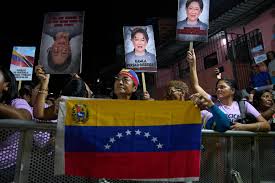
In the heart of Caracas, under the weight of economic siege and political firestorms, the streets erupted yesterday—not with chaos, but with a calculated chorus of defiance. On October 28, 2025, hundreds of demonstrators, mobilized by the Venezuelan government, marched against Trinidad and Tobago's Prime Minister Kamla Persad-Bissessar. Placards bearing her image waved like battle flags, branding her a "traitor" for her alignment with U.S. military maneuvers in the Caribbean. This wasn't a spontaneous uprising; it was a government-orchestrated rally, a stark symbol of how even in "war conditions," Venezuela finds space for public expression.
The trigger? A diplomatic dust-up that's turned neighbors into adversaries. Venezuela's National Assembly, dominated by President Nicolás Maduro's allies, voted unanimously to declare Persad-Bissessar persona non grata, barring her from Venezuelan soil. The accusation: She's turned Trinidad and Tobago into an "aircraft carrier" for American imperialism, applauding U.S. naval build-ups and airstrikes on suspected drug boats in the Dragon's Mouth. Maduro's regime sees this as a direct threat, especially amid U.S. claims of capturing CIA-linked operatives plotting "false-flag" attacks.
The Fire Next Door: Venezuela's Defiant Marches
Picture this: Amid hyperinflation, food shortages, and the shadow of U.S. sanctions—conditions many would call "war-like"—Venezuelans still hit the pavement. The march in Caracas was no isolated event. It's part of a broader pattern where Maduro's United Socialist Party (PSUV) rallies supporters to counter perceived external aggressions. Opposition voices, like Nobel Peace Prize winner María Corina Machado, decry the 2024 elections as rigged, yet even they navigate a space for dissent that, while risky, isn't outright suspended.
National Assembly President Jorge Rodríguez didn't mince words, flashing Persad-Bissessar's photo during the session like a wanted poster. "For being a traitor... lending her territory to attack Venezuela," he thundered. Vice President Delcy Rodríguez piled on, accusing Trinidad of complicity in U.S. plots after the USS Gravely docked in Port of Spain. In response, Venezuela suspended gas deals critical to Trinidad's energy sector—a economic jab that stings harder than words.
"In any country, supporting espionage against a sovereign nation justifies declaring someone persona non grata." – Venezuelan MP Pedro Infante
These "protests" aren't just anti-Kamla; they're a flex of sovereignty. Under duress—border skirmishes, mercenary incursions, and U.S. bounties on Maduro's head—Venezuela's regime uses the streets to unify, propagandize, and push back. No State of Emergency (SOE) clamps down on assembly here; it's a tool in the arsenal of resilience.
Silenced Drums: Trinidad's SOE Shackles
Now, pivot 11 kilometers across the bay to Trinidad and Tobago. Here, the air is thick with frustration, but the streets? Deathly quiet. Our SOE—imposed to combat surging crime, gang wars, and the Tren de Aragua's tentacles—has morphed into a gag order on dissent. Record murders, porous borders, and economic wobbles from Venezuelan gas cuts, yet we can't muster a murmur without risking arrest. Persad-Bissessar herself shrugs off the persona non grata label: "Why would I want to go to Venezuela?" she quipped. Bold words from the top, but for the average Trini fuming over port shutdowns or Nutrien layoffs, it's salt in the wound.
The irony bites deep. We're the ones preaching sovereignty, aligning with U.S. hawks like Marco Rubio on energy security, yet our own freedoms are curtailed. Persad-Bissessar vows no blackmail: "Our future doesn't depend on Venezuelan gas." Fair enough—diversify we must. But when Venezuelans, battered by "war conditions," can rally against us, while we whisper complaints online or in WhatsApp groups, it exposes a bitter truth: Our SOE isn't just about gangs; it's a shield for uncomfortable policies.
- Crime vs. Rights: SOE targets Tren de Aragua, but at what cost? Mass deportations loom for Venezuelan migrants—many fleeing the very chaos Maduro's foes protest.)
- Energy Blackmail: Suspended gas deals hit our pockets, yet no street-level pushback allowed.
- Regional Hypocrisy: CARICOM's "Zone of Peace" rings hollow when U.S. ships dock here unchallenged.
Lessons from the Gulf: Time to Unshackle?
Venezuela's marches, scripted or not, remind us that public space is oxygen for democracy. Even in turmoil, they debate, declare, and demonstrate. Trinidad? We're holding our breath under SOE, watching Maduro's machine grind on without reciprocal roar.
Persad-Bissessar's stance—deadly force against incursions, no bowing to bullies—is rational, as one letter writer notes. But true strength lies in empowering voices at home. Lift the SOE's veil on assembly; let us protest policies, not just pray for peace. Until then, Caracas's echoes mock our silence—a Caribbean cautionary tale of freedoms foregone.